EU energy requirements for housing cooperatives: what applies in 2026
No, your cooperative does not have to renovate to energy class D. How the EPBD, the new A0 energy class and the energy performance certificate work in Sweden after the 2026 rule changes.
In June, the chair of a cooperative board in Högsbo forwarded an email. The sender was a supplier we had never heard of, and the message was clear: the EU's new buildings directive forces the cooperative to reach energy class E by 2030 and D by 2033, or face sanctions. The last line was an invitation to a free meeting.
The claim is circulating widely. It appears in supplier mailings, in web articles and in at least two of the results you get if you search for the question today. It is also wrong.
Short answer: Sweden is introducing no mandatory minimum energy class requirements for residential buildings. The requirement to renovate the worst-performing buildings applies to non-residential premises, not to apartment buildings. Your cooperative must have an up-to-date energy performance certificate, you should know your energy class, and the measures that were profitable before the EPBD are still profitable. But you do not need to panic renovate, and you should definitely not buy anything from whoever claims you must.
What the EPBD is
EPBD stands for the Energy Performance of Buildings Directive, the EU directive on the energy performance of buildings. The recast version was adopted in 2024 and must be transposed into Swedish law by 29 May 2026 at the latest.
A directive is not a law that applies directly. It sets a goal and leaves it to each member state to decide how to get there, often with several options built in. It is precisely within that room for manoeuvre that the Swedish residential sector ended up – and the reason the headline of that email was misleading.
The difference the email missed: homes versus non-residential premises
The directive treats residential and non-residential buildings in two completely different ways.
| Residential (incl. apartment buildings) | Non-residential premises | |
|---|---|---|
| Mandatory minimum energy class | No | Yes |
| What applies instead | A national trajectory for the average of the whole building stock | The worst 16% improved by 2030, the worst 26% by 2033 |
| Who carries the requirement | The state, collectively | The owner of the individual building |
| Consequence for an individual cooperative | No forced measures | May become obliged to act |
For residential buildings, the directive requires the average primary energy use of the stock to fall – under the basic rule by 16 per cent by 2030 and 20–22 per cent by 2035, counted from 2020. But because Sweden has less than 15 per cent fossil energy in its residential sector, the country may instead choose a linear trajectory up to 2050. Sweden has used that option. In the Swedish proposal, the combined efficiency target for the housing stock is in the order of 10 per cent by 2050, and it is a target for the state to steer towards – not a requirement directed at your cooperative.
For non-residential premises it is different. There, minimum energy performance requirements apply, and the Swedish National Board of Housing, Building and Planning (Boverket) has estimated that in the order of 31,000 non-residential buildings will need energy efficiency improvements by 2033. Direct electric heating and electric boilers are heavily over-represented among the worst performers, and for them the measure is usually a switch of heating system to a heat pump or district heating.
If your cooperative owns non-residential premises – a shop on the ground floor, an office, a rented-out basement workshop – that is the part you should look at more closely. Not the apartments.
That is the nuance that disappears in supplier mailings, and it is the whole difference between a ten-million-kronor project and no action at all.
The new energy class A0
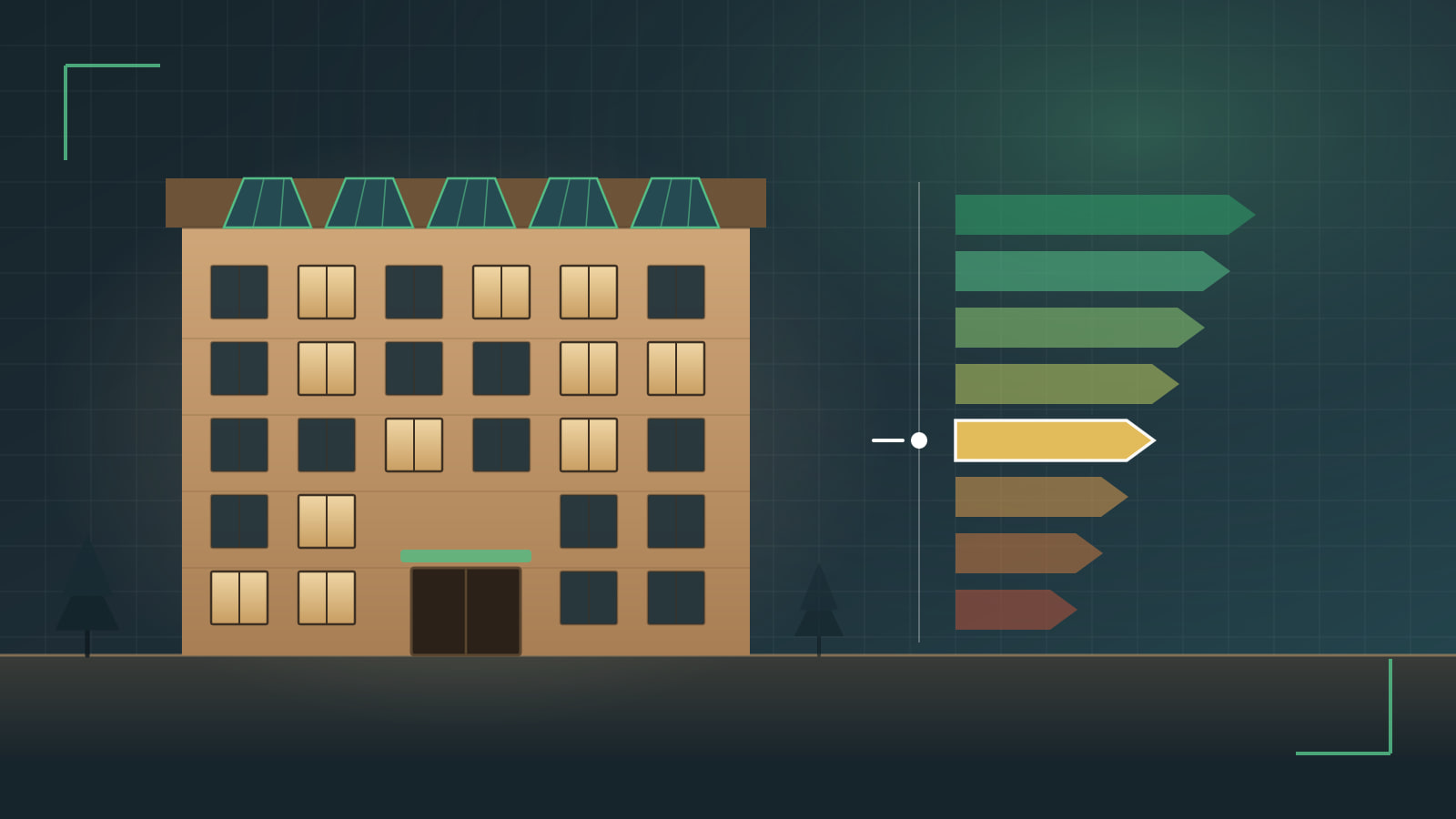
On 25 May 2026, a new class was introduced on the Swedish scale: A0, for zero-emission buildings. The scale now runs A0, A, B and on down to G.
A0 requires three things at the same time:
- Energy performance equivalent to class A
- No on-site energy from burning fossil fuels
- Building systems that can respond to external signals, so that the building can adapt its energy use
Point three is the interesting one and the least talked about. It is about demand flexibility: heating, ventilation and any EV charging should be controllable against price and capacity signals rather than running on a fixed schedule. For a cooperative in Gothenburg with district heating and a growing number of charging spaces, that question will come up whatever the EPBD says, because capacity-based tariffs already make it profitable.
In practice, A0 is a class for new construction and very deep renovations. A slab block from 1965 will not get there, and does not need to.
What is changing in the energy performance certificate
Here are the concrete changes that actually affect you.
- 25 May 2026: changes to Boverket's regulations on energy performance certificates came into force, and energy class A0 was introduced together with a temporary definition of a zero-emission building.
- 1 July 2026: changes to the Planning and Building Act and to the Act on Energy Performance Certificates for Buildings took effect.
- 1 October 2026: further regulations are planned to come into force as a result of the EPBD implementation.
Among the new features on the way is a renovation passport – a voluntary, step-by-step plan for how a building can move towards zero emissions over time, drawn up by a certified expert. In addition, the certificate will report the building's climate impact in operation, there will be a simplified update of the certificate after a completed renovation, and virtual site visits will be possible in some cases.
The basic requirement is unchanged: an apartment building must have a valid energy performance certificate, it is valid for ten years, and it must be drawn up by a certified energy expert. The data is public in Boverket's register, which means that a prospective buyer of an apartment in the building can look up your energy class before the viewing.
A renovation passport is not the same thing as a maintenance plan, and one does not replace the other. The maintenance plan answers when the roof needs replacing. The renovation passport answers how energy use falls over twenty years. A cooperative that already has a working maintenance plan does, however, have most of the groundwork done.
How to find out where your cooperative stands
Before anyone sells you a measure, take three figures from the energy performance certificate you already have:
- The energy class (A–G, now with A0 at the top)
- The primary energy number in kWh per square metre per year
- Atemp, the heated floor area the certificate is calculated on
If the certificate is more than seven or eight years old, it will soon be invalid anyway, and a new one costs a fraction of the cheapest proposed measure. If the cooperative has changed its heating system, added insulation or carried out a pipe replacement since then, the old figure is also misleading to your disadvantage.
Then compare with the statistics for similar buildings. A Swedish apartment building from the sixties or seventies is typically in class D or E. In other words, it is not an alarm. It is the normal situation for a large part of the stock, and that is exactly the insight that is missing when someone calls and says you are in a bad position.
The measures that actually pay off – in the right order
The most common expensive mistake we see is a cooperative starting at the wrong end. Solar panels and new windows are visible and easy to decide on. They are rarely what gives the most per krona.
1. Measure and balance before you invest. Balancing the heating system, checking the supply temperature curve, replacing broken thermostatic valves and a regular review of the district heating substation. Low investment, often a saving of a few per cent, and a prerequisite for being able to evaluate everything that comes after.
2. The ventilation. Many buildings from the period have extract ventilation without heat recovery. Recovering heat from the extract air, with an exhaust air heat pump or balanced ventilation with heat recovery (FTX) where ducts can be installed, is the single most powerful measure for that type of building. At the same time, check that the mandatory ventilation inspection (OVK) has been passed.
3. The building envelope where it is easy. Adding insulation to the loft floor has a short payback time when the loft is unconverted and accessible. Sealing leaky junctions and replacing doors to unheated spaces also belong here.
4. Controls and monitoring. Sub-metering, operational alarms and demand-controlled ventilation. This is also where the requirement to respond to external signals is dealt with.
5. Windows – when they are worn out anyway. Replacing windows purely for energy reasons rarely adds up in a building with district heating. If the windows need replacing because they are rotten, however, the energy gain is a bonus that improves the calculation.
6. Solar panels last. A roof with solar panels is a good investment on a building that already has low and even consumption. Put them on a leaky building and you have paid to produce electricity that escapes through the loft floor. If the roof also needs replacing within ten years, the panels should be installed after the roof work, not before.
Do the sums without deductions
Two things that often make calculations fall apart at the general meeting:
The cooperative gets neither the ROT deduction nor the green technology deduction. Both are tied to private individuals and their own home. A housing cooperative is a legal entity and pays the full labour cost. That applies just as much to an energy project as to a pipe replacement.
The tax reduction for micro-production of renewable electricity, the so-called "60-öre" reduction, was abolished from 1 January 2026. If you are calculating solar panels using figures someone produced in 2024 or 2025, the income side is too high. Ask for a new calculation based on today's compensation levels, and put the emphasis on self-consumption rather than on selling surplus power.
Four questions for every supplier who gets in touch
- Which section, in which law or regulation, supports the requirement you claim applies to us?
- Does what you describe apply to residential buildings or non-residential premises?
- What saving do you promise, measured how, and what happens if it does not materialise?
- Have you taken into account that the cooperative does not get the ROT or green technology deduction?
Question one is usually enough. A serious proposal points to Boverket's regulations or to the Act on Energy Performance Certificates for Buildings. A non-serious one points to "the EU requirements" in general.
Frequently asked questions
Does our cooperative have to reach energy class D by 2033?
No. That requirement applies to non-residential premises, not to residential buildings. Sweden is introducing no mandatory minimum energy class requirements for apartment buildings. The claim is the most common inaccuracy on the subject right now.
How often does the energy performance certificate have to be redone?
It is valid for ten years. It must also be drawn up for new buildings and when selling if there is no valid certificate.
What does an energy performance certificate cost for an apartment building?
It depends on the number of buildings, their size and how much information the cooperative can provide. Get two or three quotes from certified energy experts and check that proposals for cost-effective measures are included – that is the part that has value beyond the paper itself.
Can we be forced to do something if we own non-residential premises?
Possibly. The minimum requirements for non-residential premises target the worst-performing buildings, and the Swedish implementation is being introduced in stages. If the cooperative has a commercial section with direct electric heating, that is what you should look at first, both for regulatory reasons and because it is probably the most expensive to run.
We are replacing the pipes anyway – should we do energy measures at the same time?
Yes, and it is the single biggest saving available in this context. Site set-up, scaffolding, demolition and restoration are paid for once instead of twice. Ventilation, the substation and electrical risers belong in the same project plan as the pipe replacement.
Want a basis for decisions you can trust?
Byggentra AB works with housing cooperatives and property owners in Kållered, Mölndal, Gothenburg, Lindome, Kungsbacka and the rest of Greater Gothenburg. We handle plumbing, electrical, ventilation and building work in coordinated projects, and we would rather tell you that a measure does not pay off than sell it to you.
Describe the property and we'll book a visit – free quote within 24 hours on weekdays.