Re-roofing in Gothenburg: warning signs, timeline and cost
When does a roof need replacing, what does it cost in the Gothenburg area and how long does the work take? Here is the checklist we go through on every site visit.

A roof in West Sweden takes more punishment than most parts of a building: driving rain from the west, repeated freezing and thawing in winter and long periods of high humidity. The question is rarely whether the roof needs to be replaced, but when – and whether a repair will do.
When does a roof need replacing?
Lifespan depends on the material, but in the Gothenburg climate it is roughly:
| Material | Expected lifespan | Most common problem |
|---|---|---|
| Concrete tiles | 40–50 years | Frost damage, moss |
| Clay tiles | 50–70 years | Cracked tiles, slipping |
| Standing-seam metal | 50–70 years | Rust at fixings |
| Roofing felt/membrane | 20–30 years | Blisters, cracked seams |
The age of the material is only an indicator, though. These are the signs that actually decide it:
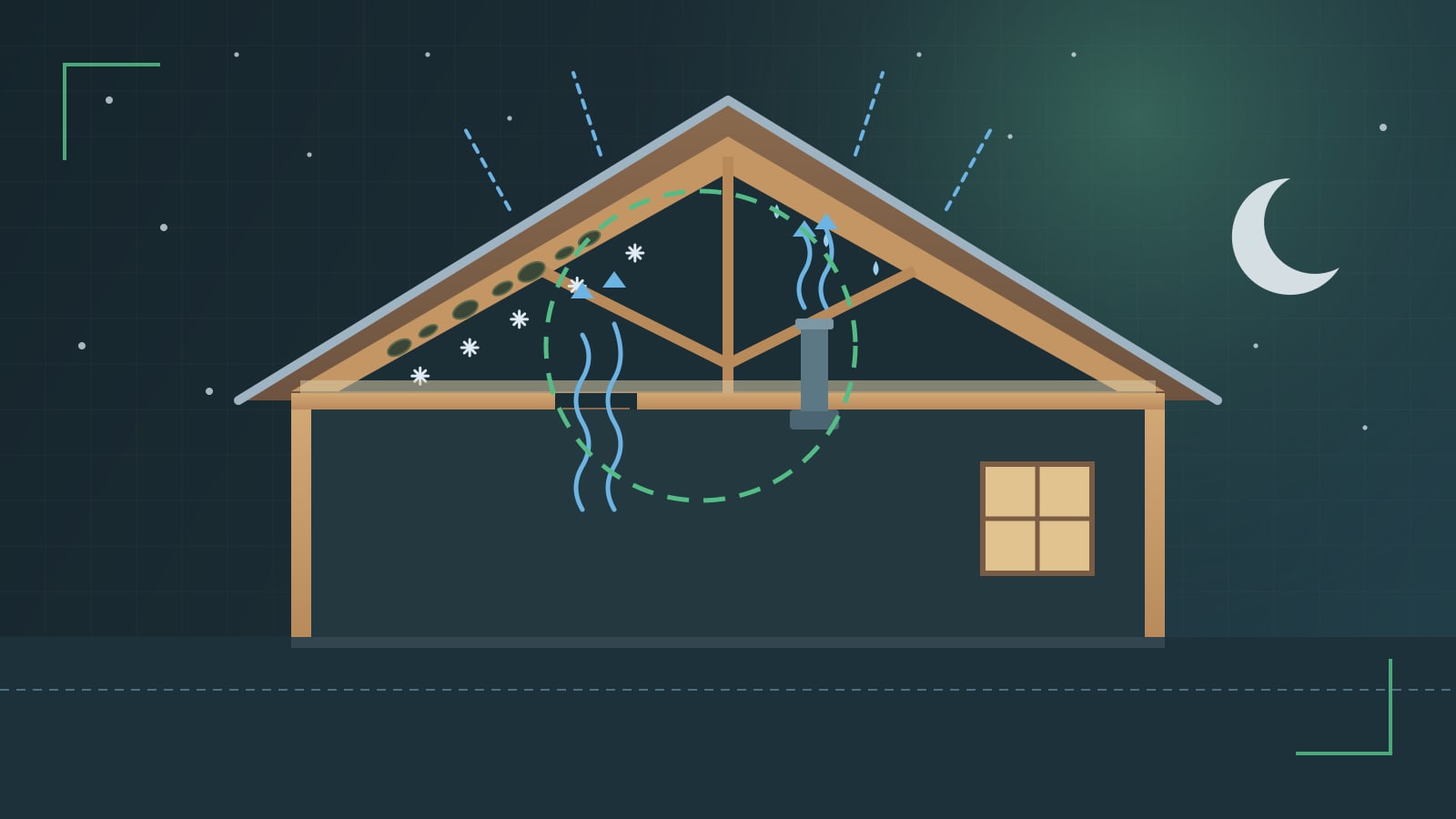
- Damp stains on the underside of the roof in the loft. Dark rings or white salt deposits mean water has got in. Go up with a torch on a rainy day.
- Moss lifting the tiles. Moss in itself is cosmetic, but its roots can wedge the overlaps apart so that water is channelled the wrong way.
- Cracked or slipped tiles. Individual tiles can be replaced, but if you find cracks spread across the whole roof, the material has reached the end of its life.
- The underlay felt is brittle. The felt is the real waterproofing layer. If it crumbles when you bend it, replacing the tiles is not enough.
- Rust around penetrations. Chimneys, vents and roof windows are where leaks most often start.
Rule of thumb: if you can point to where the problem is, it is a repair. If the problem is spread over the whole roof, it is a re-roof.
Repair or re-roof?
A repair is the right choice when the damage is limited and the rest of the structure is sound – for example after a storm that has broken a dozen or so tiles.
A re-roof is the right choice when the underlay felt is worn out. Laying new tiles on old felt means you will have to redo the whole job in five years, and by then you will have paid for scaffolding and stripping twice. Scaffolding is a significant part of the cost, so timing matters: if the façade is due to be painted or the windows replaced within a year or so, it is often cheaper to do everything at the same time.
How a re-roofing job works
1. Site visit and inspection
We go up on the roof and into the loft. We document with photos, measure the roof area and check the battens, the roof boarding and any moisture damage in load-bearing parts. This is where the real scope becomes clear – rotten roof boarding cannot be seen from below.
2. Fixed-price quote
After the visit we give you a fixed price. The quote specifies materials, scaffolding, stripping, removal of old material and labour, as well as what happens if we find hidden damage once the roof has been stripped. That point is important to read: a quote that does not cover hidden damage is not a fixed price.
3. Building permit and neighbours
Replacing like for like does not normally require a building permit, but if you change the roofing material or colour so that the character of the house changes significantly, a permit may be needed – the rules differ between Gothenburg, Mölndal and Kungsbacka. We check with the right municipality before we start.
4. Scaffolding and stripping
The scaffolding goes up first. Then the tiles and felt are stripped down to the roof boarding, which is inspected in full. Damaged boards are replaced.
5. New felt, battens and tiles
Underlay felt is laid with the correct overlap and sealed against every penetration. Then come the counter battens, tiling battens and tiles. Ridge tiles, barge boards, gutters and sheet-metal details complete the job.
6. Inspection and handover
We go through the roof together with you, document it with photos and hand over a written guarantee and documentation of the materials.
What does re-roofing cost?
The price is driven by the roof area, the pitch, the number of penetrations, the scaffolding required and the choice of material. For a normal-sized house in the Gothenburg area, the total cost is usually between SEK 1,500 and 2,500 per square metre, including scaffolding, stripping and removal.
What pushes the cost up:
- A steep roof pitch or a hard-to-reach location (more scaffolding, more time)
- Many dormers, chimneys and roof windows
- Rotten roof boarding that has to be replaced
- A metal roof instead of concrete tiles
Remember that the ROT tax deduction (rotavdrag) applies to the labour cost when re-roofing your own home. Materials are not included. We always specify the labour cost separately in the quote so that the deduction is easy to handle.
How long does it take?
A normal house takes three to seven working days when the weather allows. The scaffolding stays up a little longer. We do not lay the waterproofing layer in the rain, so the schedule always includes a weather buffer.
The best period is April to October. A roof can be replaced in winter, but the work is slower and more expensive.
Maintenance that extends the life of your roof
- Clear gutters and downpipes in spring and autumn
- Remove moss mechanically – pressure washing destroys the surface of the tiles
- Check the flashing around chimneys and vents every year
- Take a look in the loft after every real storm
A roof that is looked after often lasts ten years longer than one that is left to itself.
Want to know where your roof stands?
We make site visits in Kållered, Mölndal, Gothenburg, Lindome, Kungsbacka and Landvetter, and give you a free quote within 24 hours on weekdays. Read more about our services or describe your project and we'll be in touch.