EV charging for housing cooperatives: grants, load balancing and cost
Sweden's Ladda bilen grant covers up to SEK 15,000 per charging point. How a cooperative board plans charging spaces without upgrading the grid connection - and what it costs.
A cooperative board in Frölunda got three quotes for charging spaces. The cheapest was SEK 28,000 per space, the most expensive SEK 61,000. The board chose the cheapest, and eleven months later the cooperative had a problem: four cars could charge, the fifth had to wait, and the main fuse tripped one Tuesday evening in January when charging, cooking and the laundry room all coincided.
The difference between the two quotes was not the quality of the chargers. It was that the expensive one was based on the building's total power capacity and the cheap one was not.
Short answer: plan for the whole car park even if you build five spaces now. Load balancing matters more than charging power. Apply for the Ladda bilen ("Charge the car") grant before you place the order – it covers up to 50 per cent, at most SEK 15,000 per charging point. And expect SEK 25,000–60,000 per space depending on how far the cables have to run.
Start with the power, not the charger
The most common expensive mistake is to buy chargers first and do the electrical sums afterwards.
A building's main fuse is sized for what the building did when it was built: cooking, lighting, laundry room, lift. It is not sized for twenty cars charging at the same time. There are two ways forward:
Upgrade the grid connection. Raise the main fuse. It works technically and costs a permanently higher grid fee every month, for ever, whether or not the charging is used. For most cooperatives that is the wrong answer.
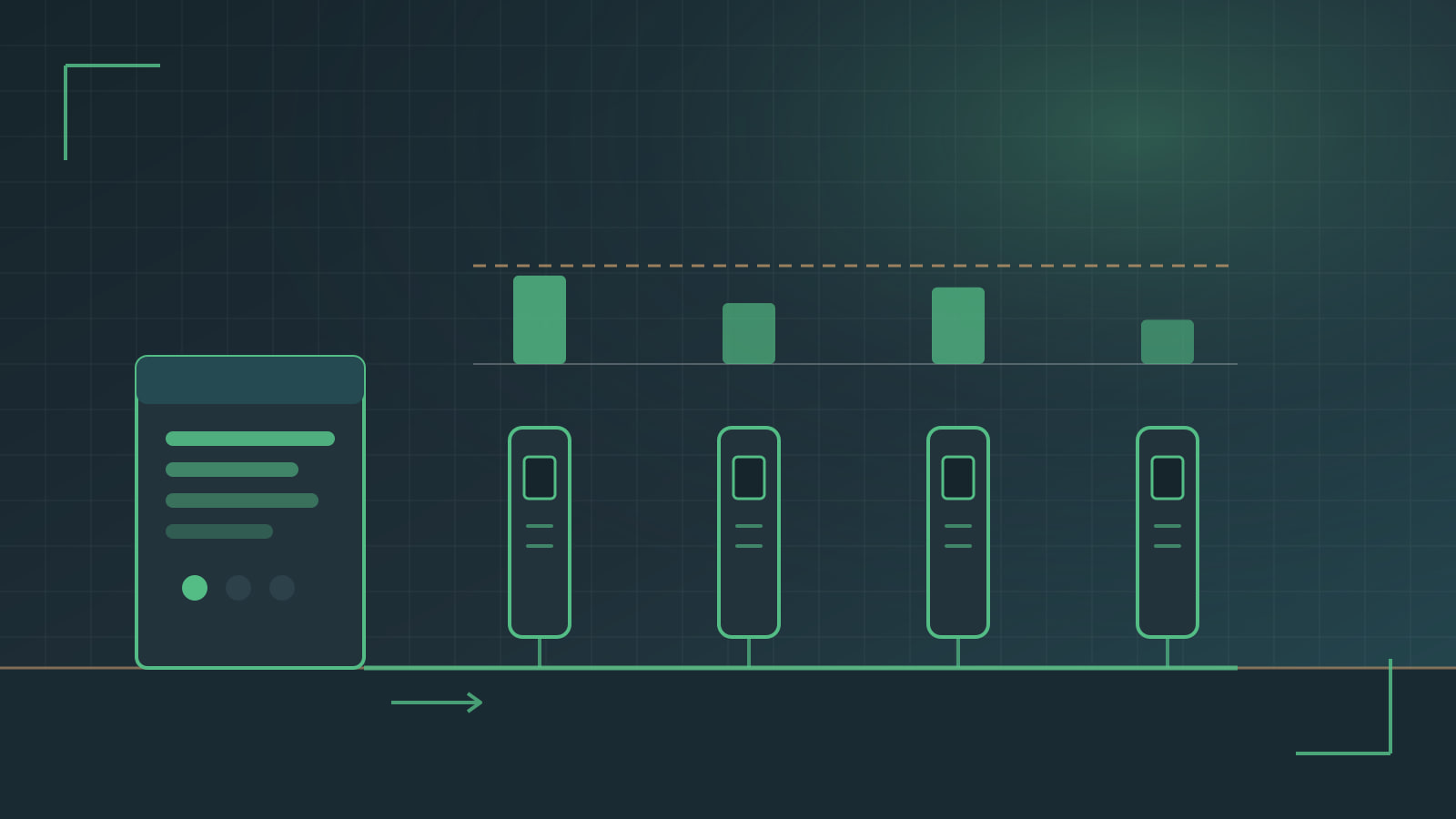
Load balancing. Let a control system measure the building's total consumption in real time and share out whatever is left between the cars. When the laundry room is running, charging backs off. When the building is asleep, the cars get full power. No higher grid fee, no tripped main fuse.
Dynamic load balancing is in practice a prerequisite for charging in an apartment building to add up. Cars are parked for twelve hours and rarely need to charge fast – they need to be charged by the morning. 3.7 kW overnight is enough for the vast majority of commuting distances.
A charging space that delivers 22 kW but can only be used by four cars is worse than one that delivers 7 kW to the whole garage.
The Ladda bilen grant
The Swedish Environmental Protection Agency's (Naturvårdsverket) Ladda bilen grant is available to housing cooperatives that install charging points for their residents.
- Up to 50 per cent of the costs
- At most SEK 15,000 per charging point
- Covers chargers, electrical installation, cabling, bringing in power capacity and groundwork
- No fixed application period – the grant is open on a rolling basis
- Applications are made via the Environmental Protection Agency's e-service
The rule that costs cooperatives money every year: apply before the work starts. A garage that has already been installed is not a grant case, it is an expense. Put the application into the schedule before the procurement, not after.
During 2026, changes have been made to the grant, including around advance applications for organisations carrying on economic activity, and the grant has been extended to cover charging points at visitor parking. The rules for grants change more often than building regulations – check the current terms and amounts with Naturvårdsverket before you budget, and don't base the calculation on an article, this one included.
What it costs
| Item | Normal range | Comment |
|---|---|---|
| Charging point in an existing garage, per space | SEK 25,000–40,000 | With short cable runs |
| Charging point in an outdoor car park, per space | SEK 35,000–60,000 | Groundwork and post extra |
| Distribution board, metering and load balancing | SEK 40,000–120,000 | One-off cost for the whole installation |
| Upgrading the grid connection | From SEK 15,000 | Plus a higher grid fee every month |
| Electrical design and power analysis | SEK 15,000–40,000 | Done before procurement |
The prices apply to the Gothenburg area and assume normal access. What drives the cost is almost always the distance from the distribution board to the car park and whether the cable can be laid in existing ducts or has to be buried.
Two items often missing from the cheap quote: the cost of the control system and metering, and the cost of preparing the spaces that are not being built now. Laying empty conduit to every space while the trench is open anyway costs little. Digging up the tarmac again in three years costs a lot.
Build for the whole car park straight away
Demand in a cooperative follows a pattern: first two members, then six, then half. If you build for today's need, you rebuild every other year.
A practical order:
- A power analysis of the building's actual consumption over a day and a year, not of the rating on the fuse.
- Ducting and empty conduit to every space in one stage.
- Distribution board, metering and load balancing sized for full build-out.
- Chargers fitted as needed, a few at a time.
That way the eleventh member who wants a charging space gets an installation day instead of a board decision, a procurement and a trench.
Metering, payment and the legal side
Every charging point must be metered individually, and the meter must be MID-certified if consumption is to be invoiced on to the member. Without approved metering, the cooperative cannot charge for actual consumption in a way that holds up, and charging on the shared electricity supply means those without a car subsidise those with one.
Three decisions the board needs to make before procurement:
- Who owns the charger – the cooperative or the member? Cooperative ownership gives a uniform system and simpler operation. Member ownership shifts the investment, but creates a mix of brands that becomes expensive to manage.
- What a charging space costs the member – a fixed monthly fee that covers the investment, plus a variable cost for the electricity.
- How spaces are allocated when demand exceeds supply.
If the charging spaces mean a significant change to the cooperative's building or land, a resolution at a general meeting may be required. Read the statutes, and get legal advice if you are unsure – it costs less than a dispute over the meeting's decision.
One thing that is often assumed wrongly: the cooperative does not get the green technology deduction. The tax reduction for green technology is tied to private individuals. The cooperative calculates on investment, grant and fee income – not on deductions.
Electrical work, safety and certification
Charging is a fixed electrical installation and comes under the Swedish National Electrical Safety Board. That means:
- The work must be carried out by a registered electrical installation company with a self-inspection programme. Check in the e-service Kolla elföretaget.
- Every charging point must have its own circuit and fault protection that can handle DC faults.
- The installation must be documented and the circuit list updated.
- Expect the building's distribution board to need reviewing at the same time. If it is from the screw-in fuse generation, charging is rarely the first measure – see replacing a fuse box.
In underground garages, fire safety issues come on top. Check how the charging spaces affect fire compartmentation, extinguishing systems and the fire service's ability to intervene, and raise it with the insurance company before the installation – not after.
Five questions for every bidder
- What power per space have you assumed at full build-out, and how have you measured the building's existing consumption?
- Is the load balancing dynamic, and what does it measure against?
- Are the meters MID-certified?
- What does it cost to add space number twelve in three years?
- Who owns and operates the system, and what does the cloud service cost per space per year?
Question four is the most revealing. A quote that cannot answer it has not planned for expansion.
Frequently asked questions
How much power does a charging space need?
3.7 to 7.4 kW is enough for overnight charging in most cases. A car parked for twelve hours then gets 45–90 kWh, which is more than most people drive in a day.
Can members get the green technology deduction for their own charger?
A private individual can get the tax reduction for green technology for a charging point at their own home. In a cooperative apartment it depends on who owns the installation and where it is. Sort that out before deciding on the set-up.
Do we need a resolution at a general meeting?
It depends on the scope and on the statutes. Smaller installations are often decided by the board. Significant changes to shared land or buildings normally require a general meeting.
What happens if everyone charges at the same time?
With dynamic load balancing, the available power is shared between the cars, and charging takes longer. Without load balancing, the main fuse trips and the whole building loses power.
How long does a project take?
From decision to operational installation normally takes two to four months for a medium-sized cooperative, much of which is design, the grant application and the grid owner's processing time.
Shall we do the sums for your car park?
Byggentra AB carries out electrical installations and charging solutions for housing cooperatives and property owners in Kållered, Mölndal, Gothenburg, Lindome, Kungsbacka, Landvetter and Partille. We start with a power analysis and a plan for full build-out, so that the first stage does not become an obstacle to the second.
Describe the property and we'll book a visit – free quote within 24 hours on weekdays.