Water damage in a cooperative apartment: who pays for what
The cooperative, the member or the neighbour? How responsibility for water damage is split in a Swedish cooperative apartment, what the age deduction means and what the quality document decides.
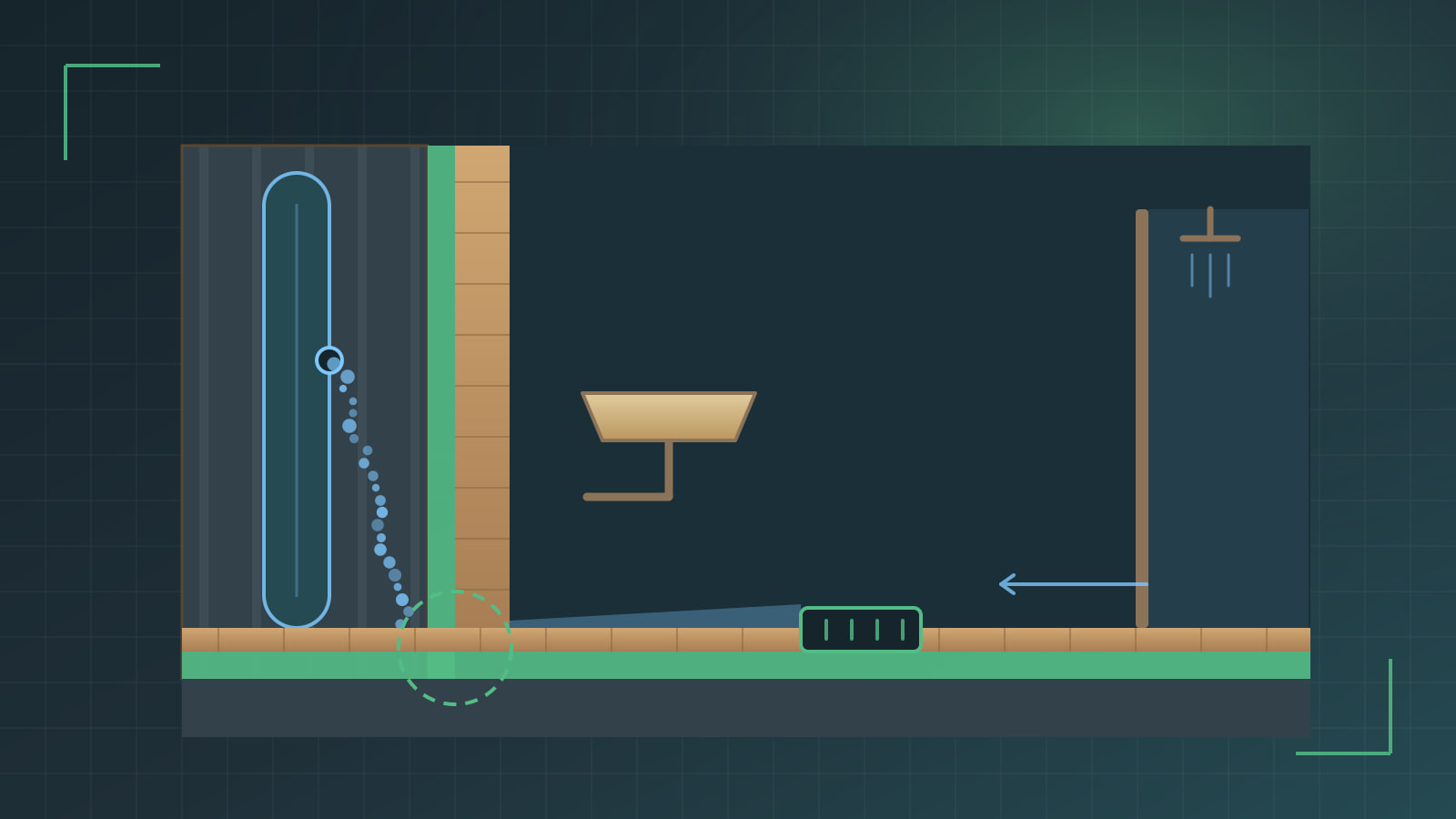
In February, a member of a cooperative in Krokslätt heard a faint hissing behind the bathroom wall. She assumed it was the neighbour's shower. In March, the parquet floor in the hallway started to buckle.
The damage was caused by a leaking water supply pipe inside the wall. The repair cost just over SEK 300,000. The interesting question was never what it cost, but who should pay which part of it – and the answers differed depending on who you asked.
Short answer: responsibility depends on what broke, not on where the damage shows. If a pressurised water pipe bursts, the cooperative is normally responsible for the cost of the consequential damage inside the apartment. For all other water damage – a leaking waterproofing layer, an overflowing bath, a broken dishwasher – the member bears responsibility for their own interior maintenance, and the cooperative-apartment add-on to their home insurance is what saves their finances.
The basic rule: surfaces versus structure
In Sweden, a cooperative apartment (bostadsrätt) is owned through membership of a housing cooperative (BRF). The Swedish Housing Cooperatives Act and the cooperative's statutes divide responsibility for maintenance in two.
The cooperative is responsible for the structure, the façade, the roof, and for the pipes and cables the cooperative has provided to the apartment that serve more than one apartment – in other words the stacks.
The member is responsible for the inside of the apartment: the surfaces of floors, walls and ceilings, fixtures and fittings, white goods, and in practice the waterproofing layer in the wet room.
The waterproofing layer is the point that decides most disputes. It sits under the tiles, it is the member's responsibility under the vast majority of statutes, and it is the most common cause of water damage in bathrooms.
Read the cooperative's statutes before you need them. They differ more between cooperatives than most members think, and it is the statutes that apply – not what was written in an article.
The decisive difference: burst water pipe or not
This is the nuance that changes the whole calculation, and it is often missed.
Burst water pipe damage (vattenledningsskada) means that a pipe under pressure – that is, a cold or hot water supply pipe – has burst. In that case, the cooperative is normally responsible for the full cost of the damage the water has caused inside the apartment, including surfaces that would otherwise be the member's responsibility.
All other water damage – blocked drains, a leaking waterproofing layer, a tap left running, a broken dishwasher hose – follows the normal division of responsibility. The member pays for their own interior maintenance.
The difference can be hundreds of thousands of kronor, and it is settled by a technical assessment on site. That is why the cause of the damage must always be investigated and documented before anyone starts tearing things out. Demolition carried out before the cause has been established destroys the evidence, and the person who loses out is usually the member.
The age deduction: why it is never as good as new
Insurance does not replace a twenty-year-old bathroom with a new one for nothing. What is deducted is called the age deduction (åldersavdrag).
The principle: waterproofing and surfaces have an estimated lifespan. If the bathroom is halfway through its lifespan, you get roughly half the value reimbursed and pay the rest yourself. If a bathroom is calculated to last 30 years, it has been written down by around 25 per cent after seven or eight years.
Three things affect the amount that comes out of your pocket:
- The excess on your home insurance, which you always pay
- The age deduction, which depends on the age of the surfaces and the waterproofing
- Any improvements you choose to make at the same time, which are never reimbursed
One important exception: in the case of burst water pipe damage, the main rule is that the cooperative, through its building insurance, covers the member's age deduction. It is one of the most frequently missed items in the whole subject, and it is worth asking about explicitly when the claims process begins.
The cooperative-apartment add-on is not optional in practice
Ordinary home insurance covers your belongings. It does not cover the interior maintenance you are responsible for as a cooperative member – walls, floors, ceilings, kitchen fittings, the bathroom surfaces.
That is what the cooperative-apartment add-on (bostadsrättstillägg) does. Without it, you pay the full cost of restoring your bathroom yourself, and that is a six-figure sum.
Many cooperatives now have a joint add-on included in the building insurance. It is cheaper per apartment and everyone is covered automatically. If you don't know which applies in your cooperative: ask the board, and do it today, not the day the parquet starts to buckle.
What the quality document does to the payout
Here comes the part that costs people the most money, and that can be prevented entirely.
A wet room must be built according to the Swedish industry rules – BBV for ceramic tiles, GVK for wet rooms with vinyl flooring, Säker Vatten for the plumbing installations. When the work has been carried out by a certified contractor, you receive a quality document at handover.
If that document is missing, or if the investigation shows that the wet room was not built to a professional standard, the insurance company can sharply reduce the payout or refuse it entirely. That applies even if you were not the one who built the bathroom – if you bought the apartment with a bathroom someone did themselves in the nineties, it is your problem now.
Therefore:
- Keep the quality document, the self-inspection record and the invoices together, digitally
- Ask for the documents when buying an apartment, just as you ask for the energy performance certificate
- If you are renovating, hire a certified wet-room contractor – read more in our guide to rules and costs when renovating a bathroom
What to do in the first 24 hours
- Turn off the water. Use the main stopcock in the apartment, or ask the caretaker to shut off the stack.
- Document. Photograph everything before anything is moved or removed, with a timestamp.
- Report it to the cooperative – the board or the property manager. In writing.
- Report it to your insurance company. Don't wait for the question of responsibility to be settled; the claim must be made without delay.
- Don't tear anything out until the cause of the damage has been established by someone impartial.
- Have moisture measurements taken before drying begins, so that the extent of the damage is documented.
Point five is the one most often broken, with the best of intentions. Someone wants to "just see what it looks like behind the tiles", and with that the basis for deciding responsibility is gone.
For the board: what you should have in place
- Clear statutes on interior maintenance, which the board has actually read
- A joint cooperative-apartment add-on, or documented checks that all members have their own
- A routine for reporting damage that members can find without phoning around
- A requirement to notify the board before a wet-room renovation, with a request for the quality document afterwards, filed per apartment
- An overview of the condition of the stacks, since burst pipes become more common the older the pipes are – the basis for that is a condition survey, which we go through in pipe replacement or relining
- The item included in the maintenance plan
A cooperative that has these six points in place handles water damage as a case to be processed. One that does not handles it as a conflict.
Frequently asked questions
The neighbour caused the damage. Can I claim money from them?
If the neighbour was negligent, you can claim compensation for your excess and your age deduction. If the neighbour was not negligent and it was a technical fault, there is normally no liability for damages.
Who pays for the drying?
Whoever owns the part of the building being dried. In practice it is often handled by the cooperative's insurance company, which coordinates the whole claim, and the costs are divided up afterwards.
Do I have to report a small damp patch?
Yes. Report even small damage, both to the cooperative and to the insurance company. A late report can reduce the payout, and moisture that has been in the wall for six months is a much bigger job than moisture discovered in time.
How long does it take to fix water damage?
Drying typically takes three to eight weeks depending on the construction. Then comes the restoration, which for a bathroom is another four to six weeks. Expect two to four months in total.
Can the cooperative require me to use its contractor?
The cooperative decides on work within its own area of responsibility. For your interior maintenance you choose for yourself, but the cooperative may set requirements for certification and documentation – and is wise to do so.
Do you have damage, or want to avoid the next one?
Byggentra AB works with housing cooperatives, property owners and private individuals in Kållered, Mölndal, Gothenburg, Lindome, Kungsbacka and the rest of Greater Gothenburg. We handle plumbing, building work and wet rooms under the same contract, with a certified wet-room contractor and a quality document at handover – the document that decides the payout the day something goes wrong.
Describe the situation and we'll be in touch – free quote within 24 hours on weekdays.