Kitchen renovation 2026: cost, ROT deduction and new leak rules
A new kitchen in Sweden usually costs SEK 150,000–350,000. How to calculate the ROT deduction, what the cooperative board must approve and which leak protection has applied since 2026.
What a new kitchen costs can be worked out. What is harder to see is what the quote does not mention: what should go under the sink, who has to approve a new cooker hood duct and which hours actually qualify for the ROT deduction.
The kitchen is also the most exposed room in the home. The water damage report from May 2026 shows that 39 per cent of water damage in Swedish houses in 2025 happened in the kitchen, and that damage there rose to new record levels for the eighth year in a row. Since 1 January 2026, the industry rules also set higher requirements for protection.
Short answer: a full renovation of a 10–15 square metre kitchen usually costs SEK 150,000–350,000 before the ROT deduction. The ROT deduction is 30 per cent of the labour cost, which in a normal kitchen often comes to roughly SEK 20,000–35,000. For installations starting after 1 January 2026, there must be a watertight layer with a moisture sensor under the sink, and a drip tray with a moisture sensor under the dishwasher. If you live in a cooperative apartment, the board's permission is required if you alter pipes or ventilation.
What does it cost to renovate a kitchen?
The price is driven above all by how much of the old kitchen you keep. The ranges below are market guide prices from the Swedish quote service Offerta's price guide in autumn 2026, including materials and labour but before the ROT deduction. It is not a price list: nobody knows what your particular kitchen will cost until someone has seen it on site.
| Scope | What is included | Approximate cost |
|---|---|---|
| Surface makeover | Painted or wrapped doors, new worktop, the carcasses stay | SEK 25,000–60,000 |
| New doors and worktop | The carcasses stay, electrics and plumbing adjusted if needed | SEK 60,000–120,000 |
| Full renovation, 10–15 m² | New carcasses, worktop, appliances, possibly a new layout | SEK 150,000–350,000 |
| High-end full renovation | More expensive units, worktop and appliances | SEK 250,000–400,000 |
For comparison, Kalkylio's trades barometer for autumn 2026 puts a standard 12-square-metre kitchen at SEK 151,000, of which SEK 59,000 is labour. That is a calculated guide figure for a typical house project, not a price for the Gothenburg area.
What drives the price:
- Moving the sink or the cooker. New runs of water, drainage and electrics are what most often turns a kitchen replacement into a rebuild.
- Units and appliances. This is where the range is widest. Offerta gives SEK 70,000–250,000 for a normal-sized kitchen.
- The worktop. A made-to-measure stone worktop costs more and also drives the schedule, because it is only measured once the carcasses are in place.
- What is behind the wall. In older houses the old wiring is rarely enough for a modern kitchen. Sometimes more circuits or a new fuse box are needed.
- Unexpected faults. Build in a buffer. Offerta allows at least SEK 15,000, and in an older house that is more of a floor than a ceiling.
How much the ROT deduction gives
The ROT deduction is 30 per cent of the labour cost, at most SEK 50,000 per person per year. So it is calculated on the labour, not the total. Using Kalkylio's example, the deduction comes to SEK 17,700, and the price goes from SEK 151,000 to SEK 133,300. If the labour is SEK 60,000–120,000, which is a common range for carpenters, electricians and plumbers together, the deduction ends up at SEK 18,000–36,000.
This is where the Swedish Tax Agency draws the line in a kitchen:
| Qualifies for ROT | Does not qualify for ROT |
|---|---|
| Fitting kitchen units and installing appliances as part of the renovation | Kitchen units, appliances and other materials |
| Replacing, painting or lacquering kitchen doors on site | Doors lacquered at the company's premises |
| Running water, drainage and electrics, fitting sockets | Fault-finding as the only work |
| Installing mixers, taps and automatic leak shut-off valves | Removal of building materials and old cupboards |
| Removing walls, painting and wallpapering | Repairing a dishwasher (that is RUT work) |
Three pitfalls to know about:
- Replacing an appliance on its own gives nothing. Installing appliances only counts as ROT work when it is part of a renovation.
- New houses. Conversion work gives no ROT deduction for the first five years after the year the house was completed. Repairs and maintenance are not covered by that restriction.
- Payment decides. It is the payment date that determines which year the deduction falls in, and payment must be electronic.
The cap, splitting between two owners and how the reconciliation works are covered in our guide to the ROT deduction in 2026.
The new requirement: leak protection under the sink
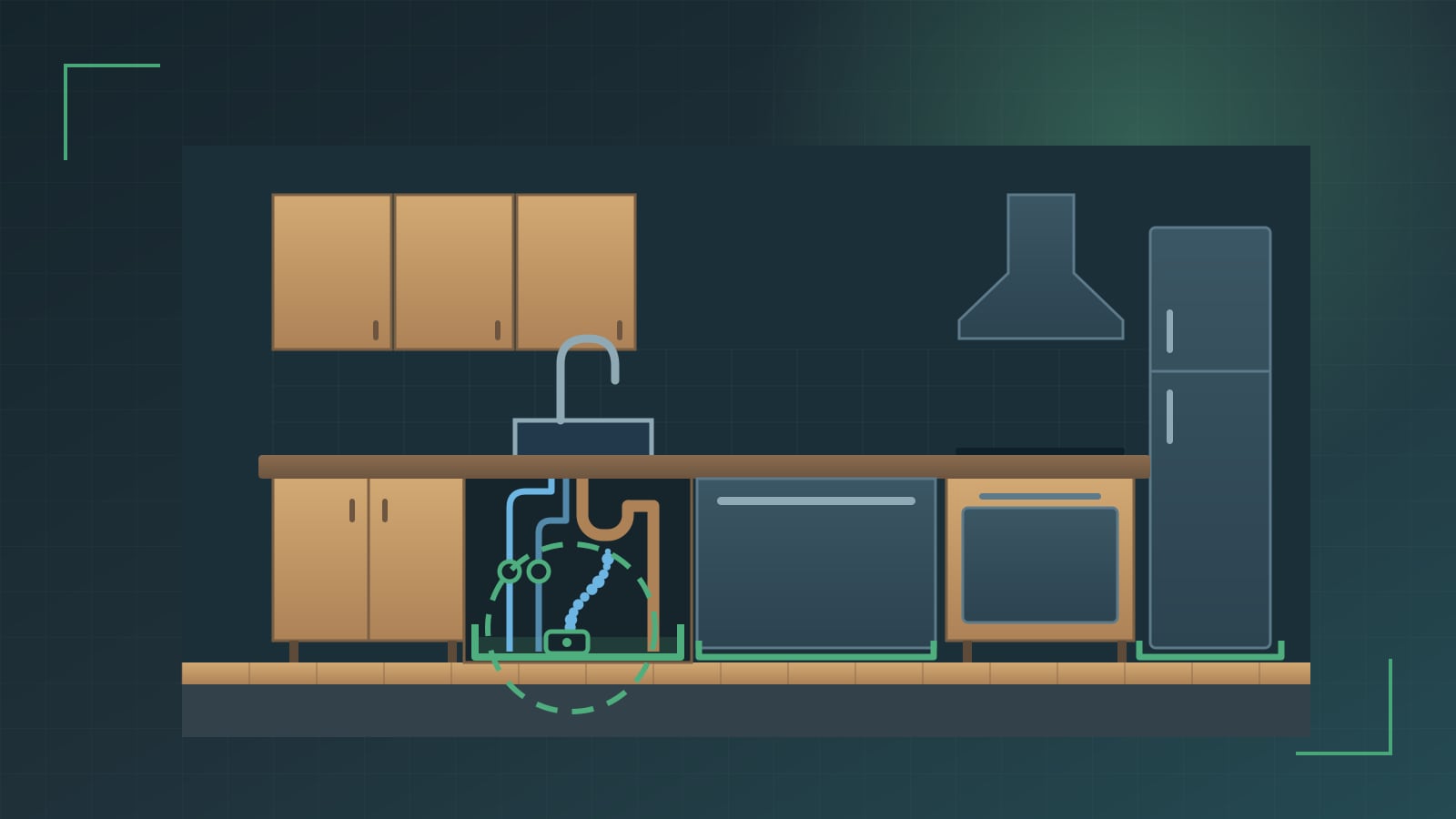
The Säker Vatten industry rules 2026:1 came into force on 1 January 2026 and tighten the requirements for both passive and active protection in kitchens. A leak must end up on a watertight floor, in a watertight insert or in a drip tray, and the insert or tray must have a moisture sensor that sounds an alarm or shuts off the water.
The details are in the industry recommendation on protection against water damage in kitchens, which Säker Vatten produced together with, among others, Insurance Sweden (Svensk Försäkring), and which has been verified by the research institute RISE:
| Where in the kitchen | What must be in place |
|---|---|
| Sink cabinet | A watertight layer in or under the cabinet with a sensor connected to an alarm, unless the floor is watertight with upturned edges |
| Dishwasher, coffee machine | A drip tray with a moisture sensor and an easily accessible shut-off valve |
| Plumbed-in fridge or freezer | A drip tray or insert with a moisture sensor and an easily accessible shut-off valve |
| Fridge without water connection | A drip tray or insert with a water alarm |
In a new kitchen, the watertight layer should be on the floor under the cabinet rather than in the cabinet itself. That way, leaks from the joint between the drain pipe and the sink trap are also caught.
Protection comes in three levels:
- A water alarm sounds when the sensor detects moisture. It only helps if someone is at home and hears it.
- A leak stop valve is a sensor-controlled valve that shuts off the water locally, usually on both the cold and hot water in the sink cabinet.
- An automatic leak shut-off valve for the whole home sits after the water meter, monitors the entire installation and shuts off the water centrally.
The recommendation points to the leak stop valve and the whole-home shut-off valve as the better protection, because the water is actually turned off. Installing a whole-home shut-off valve also qualifies for the ROT deduction.
New appliances are no protection in themselves. According to the Swedish Water Damage Centre (Vattenskadecentrum), it is most often appliances less than ten years old that cause the water damage.
Is this law?
No, these are industry rules. But they are a way of showing that Boverket's requirements are met, and Boverket's regulations state that building parts at risk of water leakage must have features that limit the leakage or its damage. Insurance terms also require professional workmanship. Säker Vatten has previously warned that an installation that does not follow the rules can lead to a lower payout or a higher excess. The same reasoning as for the waterproofing in a bathroom therefore applies here: keep the certificate.
An authorised plumbing company must issue a digital certificate, now no later than four weeks after the work is finished.
Who has to approve what?
Cooperative apartment: the board's permission
Under Chapter 7, Section 7 of the Swedish Housing Cooperatives Act, the board's permission is required for, among other things:
- alterations to a load-bearing structure
- installing or altering pipes for drainage, heating, gas or water
- installing or altering ventilation equipment
- any other significant change to the apartment
In a kitchen, that means a moved sink, a new cooker hood duct and a removed wall normally require permission. New cabinets, doors and appliances in the same place normally do not, but the statutes may say more, so read them first.
The board may only refuse if the work would cause appreciable damage or inconvenience to the cooperative. The cooker hood is a common stumbling block, because the ventilation in an apartment building is often shared. So don't choose a hood model before you know which system the building has.
House: notification to the municipality
An ordinary kitchen replacement requires nothing from the municipality. Notification is required if the change significantly affects load-bearing parts or fire safety, or if you install or significantly alter water, drainage or ventilation. In that case the work may not start until you have received a start notice. If a load-bearing wall is to be removed to open up the kitchen, that belongs in the planning stage, not in demolition week.
Electrics: a registered company
According to the Swedish National Electrical Safety Board, changes to the fixed installation, such as new sockets in the kitchen and cables in walls, must always be done by a registered electrical installation company. Permanently connecting an electrical appliance also counts as electrical installation work. As the owner of the home, you are responsible for making sure the right company does the job, and you can check this in the e-service Kolla elföretaget.
In what order is the work done?
- Measure and plan with the plumber and electrician at the table, before anything is ordered. This is where leak protection, the hood and the position of sockets are decided.
- Apply for permission from the board or submit a notification, if needed.
- Order the kitchen and appliances. Don't start demolition until delivery is confirmed.
- Demolition. Water and electricity are disconnected and the substrate is checked.
- Plumbing and electrics are run while walls and floors are open.
- Floors, walls and ceilings are finished.
- Carcasses and leak protection are fitted.
- The worktop is measured. A made-to-measure worktop often takes two to three weeks from measuring to delivery.
- Worktop, sink, mixer and appliances are fitted and connected.
- Self-inspection and handover, with pressure testing, certificate and walkthrough.
Expect roughly a month on site for a full renovation without major rebuilding, and add time if water and drainage are to be moved. The kitchen is also out of use in the meantime, so plan for a temporary washing-up area and a way to cook.
Seven questions for the contractor
- Does the plumbing follow Säker Vatten installation rules 2026:1, and will I get a certificate?
- Which leak protection is included under the sink, dishwasher and fridge?
- Which registered electrical installation company does the electrical work?
- Are labour and materials specified separately, with the ROT deduction calculated?
- How is hidden damage discovered during demolition handled?
- Who is responsible for deliveries, the schedule and waste removal?
- Who takes care of the board's permission or the notification to the municipality?
If you get a vague answer to question 1 or 2, it is worth asking again. Those are the two that show first the day something leaks.
Frequently asked questions
What does it cost to renovate a kitchen in 2026?
A full renovation of a 10–15 square metre kitchen usually costs SEK 150,000–350,000 before the ROT deduction. If you keep the carcasses and replace the doors and worktop, the cost is often SEK 60,000–120,000.
How much does the ROT deduction give on a kitchen?
30 per cent of the labour cost, at most SEK 50,000 per person per year. With a labour cost of SEK 60,000, the deduction is SEK 18,000. Materials and appliances are never included.
Do I need a water alarm under the sink?
For installations starting after 1 January 2026, the industry rules require a watertight layer with a sensor, unless the floor is watertight with upturned edges. The rules apply to installation work and do not force you to rebuild an existing kitchen, but a water alarm is a small cost compared with water damage.
Can I replace the kitchen in my cooperative apartment without asking the board?
Yes, if you replace cabinets, doors and appliances in the same place, unless the statutes say otherwise. If you move the sink, alter the ventilation or remove a wall, you normally need the board's permission.
Can I fit the kitchen myself?
You can fit the carcasses, doors and worktop yourself, but then the work does not qualify for the ROT deduction. Changes to the fixed electrical installation must be made by a registered electrical installation company. Water and drainage should be done by a plumbing company that works to Säker Vatten, since insurance terms require professional workmanship.
How long does a kitchen renovation take?
Roughly a month on site for a full renovation without major rebuilding. Also plan for the delivery time of the kitchen and two to three weeks for a made-to-measure worktop.
Shall we take a look at your kitchen?
Byggentra AB is based in Landvetter and renovates kitchens in Härryda, Gothenburg, Mölndal, Kållered, Partille, Lindome and Kungsbacka. We coordinate building work, plumbing and electrics in the same project and split labour and materials in the quote, so you can see your ROT deduction before you sign.
Describe your kitchen and we'll be in touch – free quote within 24 hours on weekdays.
The rules and prices above apply at the time of publication. The prices are market guide figures and do not replace a quote. Check the current terms with the Swedish Tax Agency, Säker Vatten and your cooperative before a project. Most of the linked sources are in Swedish.