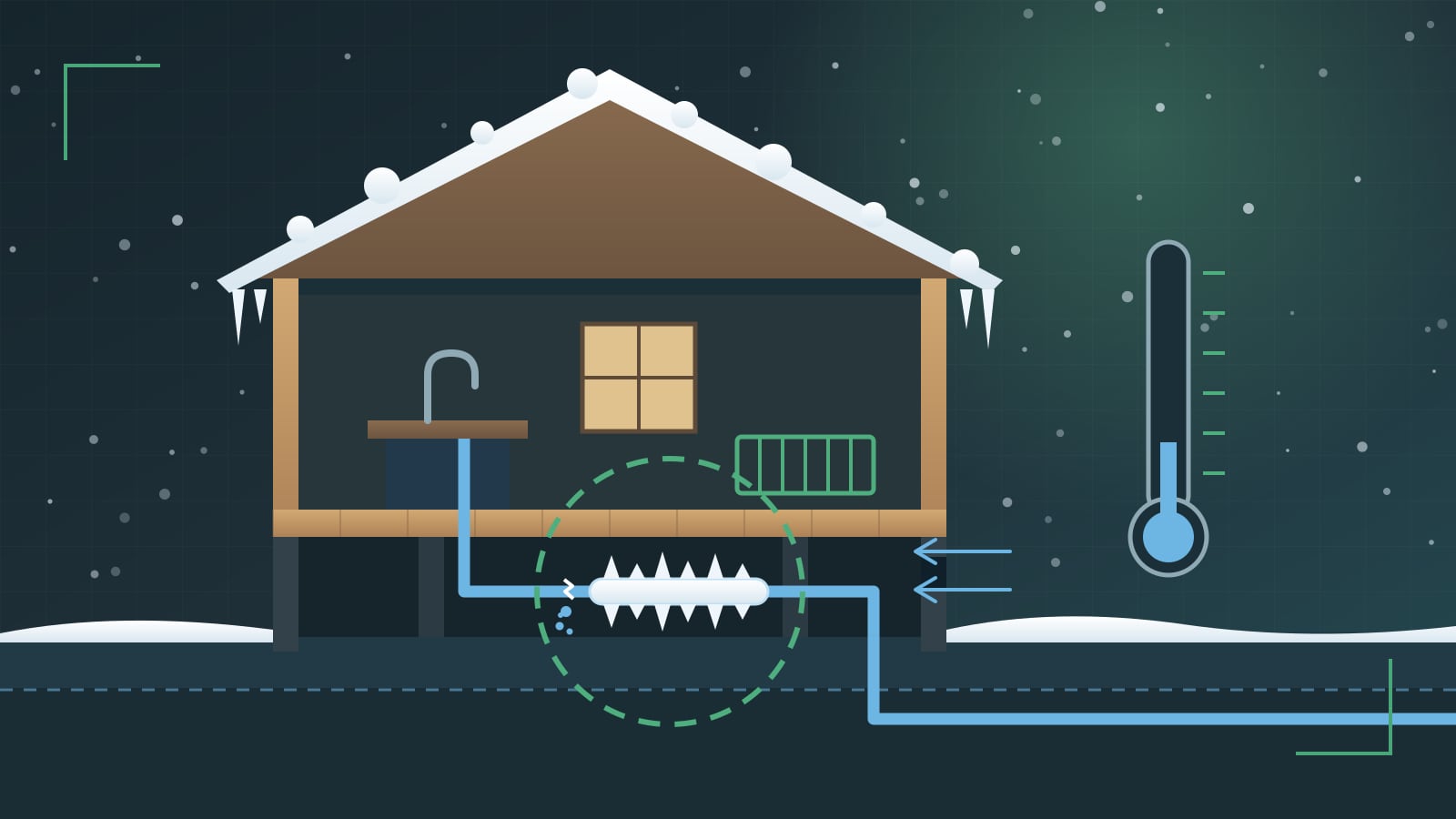
Damp and mould in the loft: causes, signs and solutions
Dark patches on the roof boarding and frost in the loft on a clear winter morning? How damp and mould develop in a cold loft, how to check it and what helps.
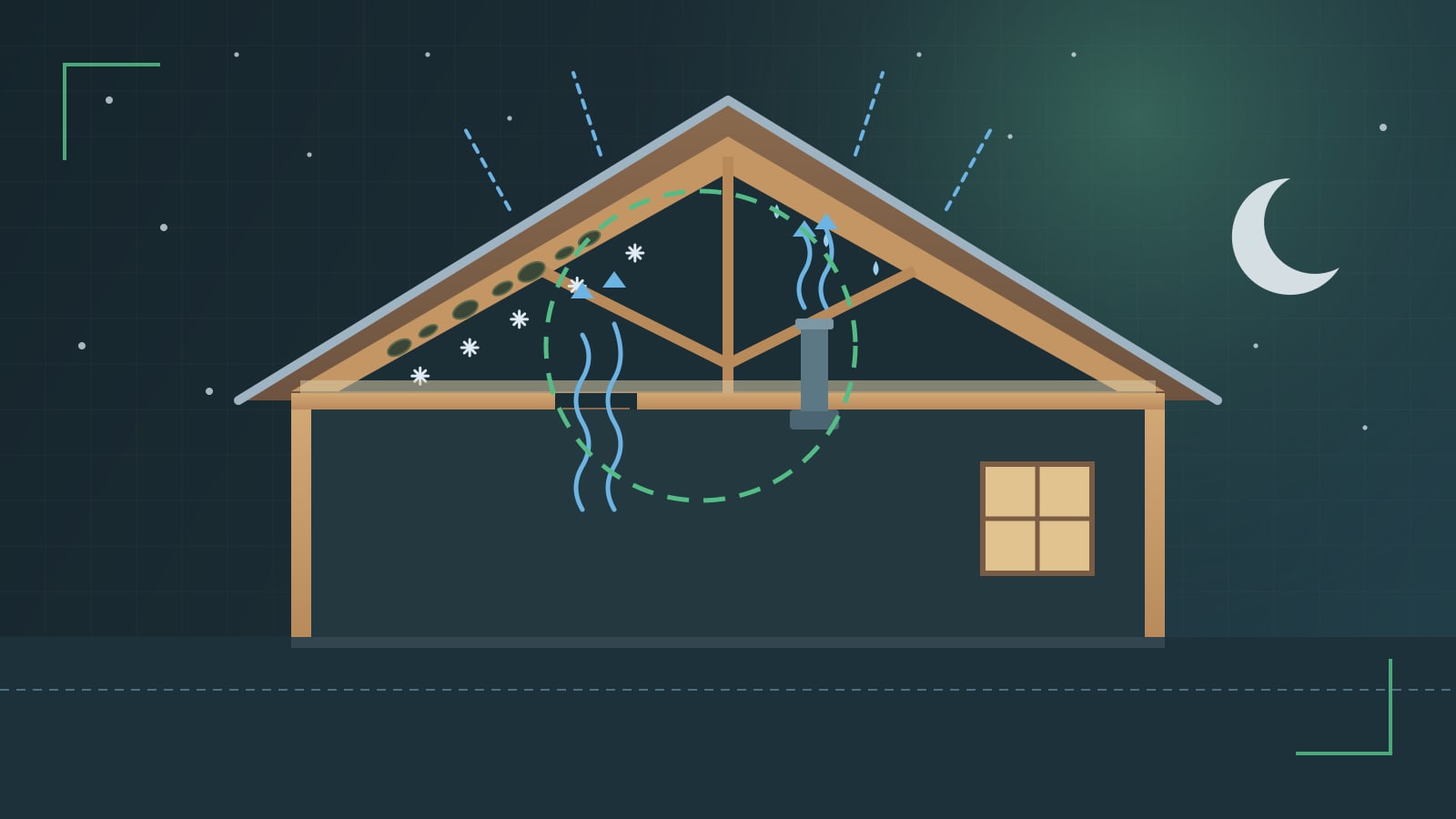
Damp in the loft rarely comes from a hole in the roof. Most often it comes from inside the house: warm, humid indoor air that leaks up through the loft floor and condenses against the cold roof boarding. On a clear winter night the roof also cools down so much that even the outdoor air in the loft can start to condense. If that happens winter after winter, mould takes hold.
Short answer: start by sealing the loft floor and the loft hatch and make sure that extract air from the bathroom and kitchen is led all the way outside, not into the loft. More ventilation is not always better. Check the loft on a cold, clear morning and look for frost, droplets, dark patches and rusty nails. If you find growth, the cause must be fixed first, and damaged material replaced. According to the Public Health Agency of Sweden, just spraying with mould treatment has limited effect.
Why a cold loft gets damp
A cold loft is a roof space where the structure is at roughly the same temperature as the air outside. According to the Swedish National Board of Housing, Building and Planning (Boverket), it is a common roof design that often suffers moisture damage. The moisture can come from precipitation, indoor air, outdoor air and construction moisture. Three mechanisms account for most of it.
Humid indoor air leaking up. Indoor air usually contains more water than outdoor air. When it finds its way up through gaps in the loft floor – around the loft hatch, around pipes and cable penetrations – it cools down and the relative humidity rises quickly. Boverket explains that it takes both a hole and overpressure inside, and that the risk is greatest in winter. That is when the temperature difference is greatest, and the difference drives warm air upwards through the house.
Night-sky radiation. On a cold, clear night the roof radiates heat towards the sky and can become colder than the surrounding air. If the surface drops below the dew point of the air, the outdoor air flowing into the loft forms condensation on the inside of the roof.
A colder loft than before. Boverket's review of how cold lofts have changed shows that several sensible energy measures have made lofts damper:
- More insulation in the loft floor means less heat reaches the loft, so the air there becomes damper and the drying capacity of the ventilation is reduced.
- Switching from wood or oil burning to, for example, direct electric heating removed the warm chimney stack that used to heat the loft.
- Milder winters have given lofts a climate that is more favourable to mould.
Boverket also writes that it is easy to believe that good ventilation solves moisture problems, but that the ventilation itself can be a source of moisture or have a limited drying effect during parts of the year.
The west coast does not make things easier. According to the Swedish Meteorological and Hydrological Institute (SMHI), relative humidity is highest at night and in winter, and the moisture content of the air is highest along the coasts of southern Sweden.
Signs to look for
- Frost or droplets on the underside of the roof boarding on a cold morning. Boverket uses exactly that as an example of air leaking through the loft floor.
- Dark patches or discolouration on the roof boarding and trusses.
- Rust on nail tips poking through the roof boarding.
- Roof boarding that lifts or has buckled.
- A musty smell in the loft, and at worst inside the house.
Moisture moves from warm to cold. When the sun warms one side of the roof, the moisture can collect on the cold side, so look especially carefully at the north-facing part of the roof.
How to check the loft yourself
- Choose a cold, clear morning. That is when frost and condensation show.
- Take a powerful torch and shine it along the roof boarding, preferably at a shallow angle so that patches and unevenness show.
- Only walk on joists or walkway boards. Between the joists, only the ceiling board of the room below is holding you.
- Look at the loft hatch. Does it close tightly, and does it have a seal?
- Follow the extract ducts from the bathroom and kitchen. Do they go all the way up through the roof, and are the joints intact?
- See whether the insulation is evenly laid and does not block the airflow at the eaves.
- Take photos of everything you see. They are valuable for whoever assesses the damage.
Wear a respirator if you see growth, and do not disturb the insulation unnecessarily.
| Cause | Typical sign | First action |
|---|---|---|
| Indoor air leaking up | Frost or damp above the loft hatch, pipes and penetrations | Seal the loft floor and the hatch |
| Extract air discharging into the loft | Damp and growth near the duct | Run the duct all the way outside |
| Night-sky radiation | Condensation evenly spread on the roof boarding on clear nights | Have a professional assess the ventilation and moisture balance |
| Leak through the roof | Damp patches under penetrations, valleys or joints | Repair the roof |
| Long-term high humidity | Dark patches, smell, rust on nails | Investigation, fixing the cause, remediation |
Measures in the right order
1. Find the cause. The Public Health Agency of Sweden writes in its supervisory guidance that the most important thing with moisture damage is to find the damage and fix the cause of it. Everything else comes after.
2. Seal the loft floor. This is usually the most effective measure, because it reduces the amount of moisture reaching the loft. A seal on the loft hatch and sealing around pipes, cables and ducts is a good start. Boverket recommends that loft hatches are kept closed and close tightly.
3. Correct the extract ventilation. A bathroom fan blowing humid air straight into the loft, or a leaky duct, is a direct source of moisture. The duct should be led out through the roof. Installing or significantly changing the ventilation may require a notification to the municipality.
4. Review the loft's ventilation. Both too much and too little outdoor air can cause problems, so this is an assessment for a professional rather than something to solve with more vents.
5. A dehumidifier if the cause cannot be fully fixed. A dehumidifier can keep the moisture in the loft down, but it uses electricity, needs looking after and does not remove growth that is already there.
6. Remediation and replacement of damaged material. The Public Health Agency writes that material damaged by moisture and microorganisms needs to be replaced with dry, clean material, and that treatment with anti-mould products has only a limited effect. Remediation releases spores, so the work must be done without spreading them down into the house. Replacing the roof boarding is a last resort, and then it is often time to look at the whole roof. Read more about when it is time for re-roofing.
Moisture measurement and investigation
A building-technical investigation shows whether there is ongoing moisture damage and how extensive it is. According to the Public Health Agency, measuring the moisture in materials can show ongoing damage and its extent. Taking mould samples shows that there is damage in the material, but it does not give a measure of the health risk.
Boverket's building regulations state that a relative humidity of 75 per cent is to be treated as the highest permitted moisture level for a material, unless there is a well-documented value for that particular material. That gives you a guideline when reading a measurement report.
Why it is worth taking seriously: Boverket states that moisture damage is present in around three in ten homes in Sweden, and according to the WHO roughly 15 per cent of all new cases of asthma in children in Europe are caused by damp and mould in buildings. The Public Health Agency also points to the risk of mould and mouldy smells spreading from the loft down into the home.
Insurance, the ROT deduction and buying a house
Insurance. House insurance is primarily for sudden damage. According to the consumer advice service Konsumenternas, leaks through the roof of a house are in principle never covered, and mould that has grown over several winters of condensation is rarely a sudden event. Read your terms and ask your insurer before counting on a payout.
The ROT deduction. In a house, adding insulation, installing ventilation and roof work qualify for the ROT tax deduction on the labour cost. Moisture measurement and inspection do not. More in our guide to the ROT deduction in 2026.
Buying or selling a house. Under the Swedish Land Code (jordabalken), a buyer cannot claim a defect that should have been discovered during an inspection of the property. If the loft is accessible and the discolouration visible, it can therefore be difficult to claim a hidden defect afterwards. The seller is liable for hidden defects for ten years, and Konsumenternas recommends that buyers have their own inspection done. Go up into the loft yourself, preferably together with the surveyor.
For housing cooperatives
In a cooperative, the loft is a shared space and the cooperative's responsibility. According to the Public Health Agency, it is the property owner who must investigate suspected moisture problems. Boverket recommends that lofts are inspected so that problems are detected early.
- Add a check of the loft every winter to the caretaker's rounds.
- Make sure loft hatches and doors to the loft are always closed.
- Don't add insulation to the loft floor without first assessing how it affects the moisture in the loft. That applies especially in an energy plan; see the article on EU energy requirements for housing cooperatives.
- At the same time, deal with the roof and responsibility for snow and ice.
Frequently asked questions
Is mould in the loft dangerous?
It depends on how much reaches the home. The Public Health Agency writes that damp and mould in buildings can increase the risk of respiratory problems and asthma, especially in children. Growth in the loft should therefore be dealt with, even though nobody lives there.
Why is there frost on my roof boarding?
The frost is moisture that has frozen against the cold roof. It comes either from indoor air leaking up through the loft floor or from outdoor air cooling down on a clear night. Frost that collects above the hatch and penetrations suggests a leak from inside.
Does it help to add more vents?
Not always. Boverket writes that the ventilation itself can be a source of moisture and that more ventilation does not automatically dry out the loft. Seal the loft floor first.
Is it enough to treat the mould with a mould product?
No. According to the Public Health Agency, anti-mould products have limited effect, and damaged material needs to be replaced. Unless the cause is fixed, the growth will come back.
Does insurance cover mould in the loft?
Rarely, since insurance primarily covers sudden damage and mould usually grows over time. Read your terms and ask your insurer.
When is the best time to check the loft?
On a cold, clear winter morning. That is when frost and condensation show most clearly.
Want help with your loft?
Byggentra AB is based in Landvetter and carries out roofing and renovation in Härryda, Gothenburg, Mölndal, Kållered, Partille, Lindome and Kungsbacka. We go up into the loft, look for the cause of the damp and propose measures in the right order: from sealing the loft floor to replacing the roof boarding when it is really needed.
Describe what you see and we'll be in touch – free quote within 24 hours on weekdays, or call +46 31 320 41 55.
The information above applies at the time of publication. Insurance terms and the rules for the ROT deduction change, so always check what applies in your case. Most of the linked sources are in Swedish.